
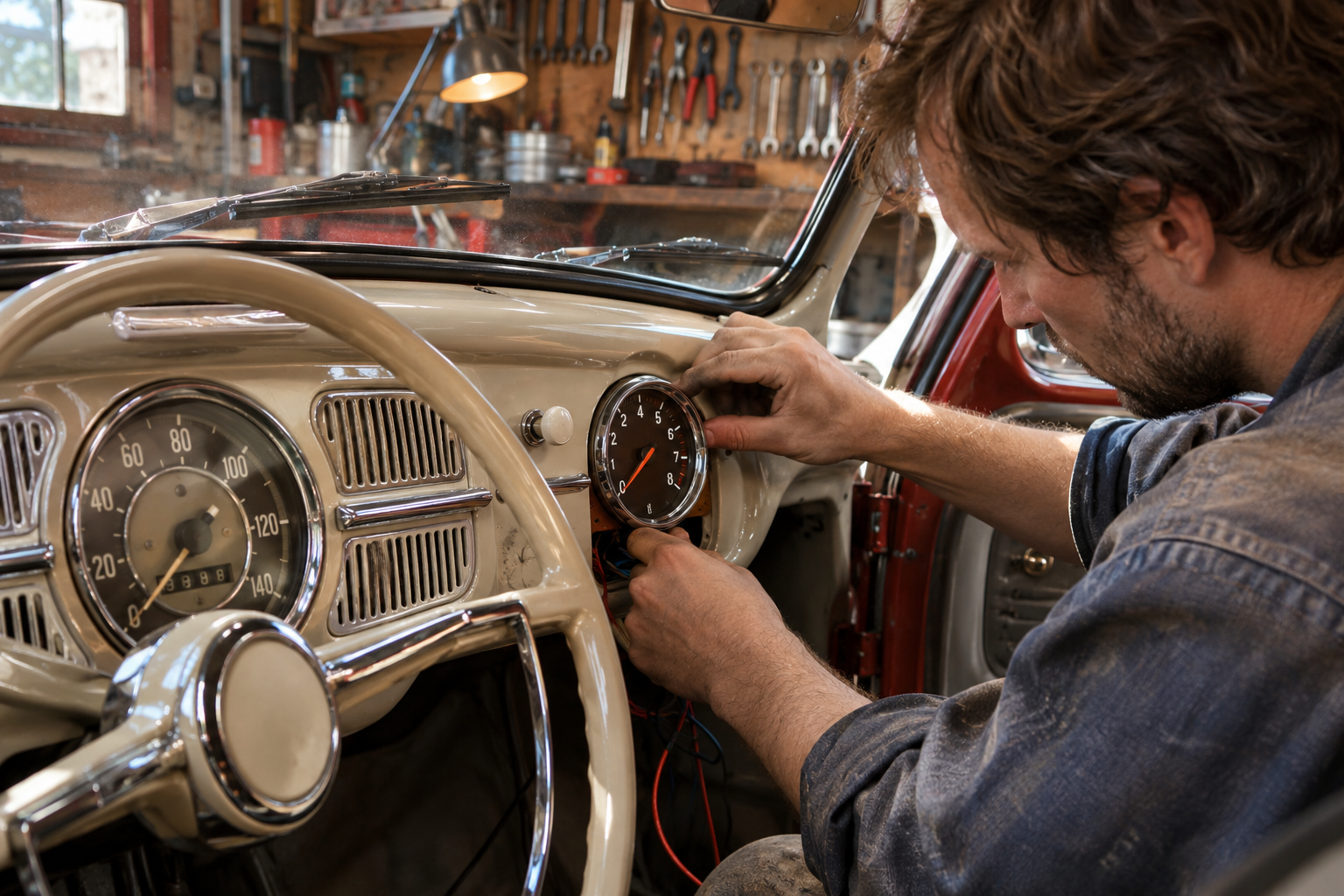
Retrofitting a Tachometer in a Classic Car: Avoid These Common Mistakes
A tachometer is not only a visual highlight in the cockpit of a classic car but also a practical instrument for monitoring engine speed. Especially in classic vehicles such as the VW Beetle, historic sports cars, and other vintage or modern classic cars, retrofitting a tachometer can be a worthwhile upgrade. However, there are several potential pitfalls when selecting, connecting, and installing the instrument. Anyone planning to retrofit a tachometer in a classic car should be aware of the most common mistakes and know how to avoid them.
The Most Important Points at a Glance
- Not every tachometer is suitable for every classic car. Important factors include the vehicle's electrical system voltage, ignition system, and engine speed signal.
- Incorrect wiring can lead to inaccurate readings or damage to the vehicle's electrical system.
- A tachometer with a classic design blends harmoniously into the dashboard of a vintage vehicle.
- The cylinder count or number of ignition pulses must match the specific ignition system.
- After installation, the displayed engine speed should be checked to identify measurement errors at an early stage.
Why Is It Worth Retrofitting a Tachometer in a Classic Car?
Many historic vehicles were originally delivered without a tachometer. While modern cars often feature extensive instrumentation, older models frequently have only a speedometer, fuel gauge, and a few warning lights. A retrofitted tachometer offers several advantages. It helps drivers monitor engine speed and adjust gear changes to the characteristics of the engine. This additional information is particularly useful for older engines, whose operating limits and speed ranges may differ from those of modern power units. In addition, a classic tachometer can enhance the appearance of the cockpit. Instruments with a retro design are particularly popular because their styling blends harmoniously with the overall appearance of the vehicle.
Installing a Tachometer: Avoid These Common Mistakes
It is certainly possible to install a tachometer yourself, but it is important to avoid common mistakes during the process.
Mistake 1: Choosing an Unsuitable Tachometer
One of the most common mistakes when retrofitting a tachometer is selecting an instrument that is incompatible with the vehicle's existing technology. The electrical system voltage is particularly important. While many vehicles are equipped with a 12-volt system, numerous older classic cars still use 6-volt electrical systems. A tachometer designed exclusively for 12 volts cannot simply be used in a 6-volt vehicle without further modifications. The ignition system also plays an important role. Traditional contact-breaker ignition systems produce different signal characteristics compared with some modern electronic ignition systems. The tachometer must therefore be explicitly compatible with the vehicle's existing technology.
When choosing a tachometer, the following characteristics should be considered: electrical system voltage, ground polarity, ignition system, number of engine speed pulses, and available connection options. Checking these factors before purchasing helps avoid unnecessary modifications and buying the wrong instrument.
Mistake 2: Connecting the Tachometer Incorrectly
Another common mistake involves the electrical installation. Especially in older vehicles, wiring arrangements and terminal designations can differ significantly from modern systems. In many conventional petrol engines with a single ignition coil, the engine speed signal is taken from terminal 1 of the ignition coil. However, this connection method is not suitable for every tachometer or ignition system. Electronic ignition systems may require a dedicated signal output or an additional adapter. Some older current-pulse-operated instruments also use different connection methods. Before installation, the vehicle's wiring diagram should therefore always be compared with the tachometer manufacturer's installation instructions. Proper electrical protection, reliable ground connections, and adequately insulated wiring are also essential.
Important: Before working on the vehicle's electrical system, the power supply must be safely disconnected. Classic cars with positive ground systems require different precautions than vehicles with negative ground systems. If you are unsure, installation should be carried out by a qualified workshop.
Mistake 3: Setting the Incorrect Cylinder Count or Pulse Rate
A correctly connected tachometer does not automatically display the correct engine speed. Incorrect instrument settings are a common cause of inaccurate readings. Many electronic tachometers can be configured for different cylinder counts or pulse rates. For example, in a conventional four-stroke ignition system with a single ignition coil, a four-cylinder engine normally produces two ignition pulses per crankshaft revolution. If the tachometer is configured for an incorrect pulse rate, it may display significantly higher or lower engine speeds than the actual values. Particular attention is required for modified engines or vehicles equipped with retrofitted electronic ignition systems. In these cases, the actual signal characteristics of the ignition system should be considered rather than relying solely on the number of cylinders.
Checking the readings with a suitable external tachometer helps verify the accuracy of the instrument after installation.
Mistake 4: Unnecessarily Modifying the Original Dashboard
For many classic cars, preserving the vehicle's original condition is an important factor in maintaining its value. Therefore, retrofitting a tachometer should involve modifications that are as gentle and reversible as possible. A common mistake is drilling additional holes in the dashboard even though alternative mounting options are available. Depending on the model, classic VW Beetles and other historic vehicles can be equipped with separate instrument brackets or suitable mounting solutions. Reversible installation offers the advantage that the vehicle can be returned to its original condition if necessary. The design of the new instrument should also match the existing dashboard as closely as possible. A tachometer with a classic dial, matching illumination, and a period-correct housing often looks more harmonious than a modern digital instrument.
Mistake 5: Routing and Securing Cables Incorrectly
Not only the electrical connections but also the routing of the wiring determines whether a retrofitted tachometer will function reliably over the long term. Running cables without adequate protection through the engine compartment or behind the dashboard can result in damaged insulation, loose connections, and electrical interference. Wiring positioned near hot engine components, moving parts, or sharp-edged openings is particularly vulnerable. Routing signal cables close to ignition leads can also cause interference with sensitive tachometer signals. This may result in a jumping needle or implausible engine speed readings. All cables should therefore be properly secured, protected against abrasion, and routed to minimize electrical interference. Suitable cable grommets and high-quality connectors contribute to a durable installation.
Mistake 6: Underestimating the Challenges of 6-Volt Classic Cars
Particular care is required when working with older vehicles equipped with 6-volt electrical systems. Many commercially available aftermarket tachometers are designed exclusively for 12-volt systems. Although suitable voltage converters can be used under certain circumstances, they do not automatically solve every compatibility issue. In addition to the supply voltage, the engine speed signal and ground polarity must also be compatible with the instrument. Another special case involves classic cars with positive ground electrical systems, as found in various historic British vehicles. Owners of such vehicles should specifically look for a compatible tachometer or a professionally designed conversion solution.
Mistake 7: Skipping the Function Test After Installation
Once the tachometer has been mounted and connected, the installation should not be considered complete without a final function test. With the engine running, first check whether the needle responds smoothly and consistently. Different engine speed ranges should then be tested. Jumping needles, delayed responses, or obviously incorrect readings may indicate problems with signal transmission, the power supply, or the instrument settings. Comparing the readings with an external reference instrument is particularly useful. This helps determine whether the tachometer is actually displaying the correct engine speed. The installation should only be considered complete after a successful function test.
Retrofitting a Tachometer in a Classic Car: What Really Matters
Retrofitting a tachometer does not necessarily require extensive modifications to the vehicle. Careful preparation is the key to a successful installation. First, determine the vehicle's technical specifications and identify an instrument that is compatible with its existing systems. Next, choose a suitable mounting location and prepare the necessary electrical connections using the wiring diagrams for both the vehicle and the tachometer. Anyone who values an authentic appearance should ideally select an instrument that visually matches the period in which the vehicle was manufactured. With the right accessories and professional installation, a tachometer can be integrated into a classic car in a way that enhances both its functionality and appearance.
Frequently Asked Questions About Retrofitting a Tachometer in a Classic Car
Can You Retrofit a Tachometer in Any Classic Car?
In principle, a tachometer can be retrofitted in many classic cars. The main requirement is the availability of a suitable instrument and a compatible engine speed signal or an appropriate retrofit solution. The amount of work required depends on the vehicle's existing technology.
Where Is a Tachometer Connected in a Classic Car?
In classic petrol engines with a conventional ignition system and a single ignition coil, the engine speed signal is often taken from terminal 1 of the ignition coil. Other ignition systems, diesel engines, or specialized instruments may require different connection methods.
Will a 12-Volt Tachometer Work in a 6-Volt Classic Car?
Not without additional considerations. A tachometer designed for 12 volts requires a suitable power supply. In addition, the ground polarity and input signal must be compatible. A voltage converter alone does not guarantee proper operation.
How Can You Tell Whether a Retrofitted Tachometer Is Working Correctly?
The displayed engine speed should change smoothly as the engine accelerates or decelerates and should provide plausible readings. A reliable way to verify accuracy is to compare the readings with an external tachometer. Jumping needles or significantly incorrect values often indicate signal or configuration problems.
Which Tachometer Is Suitable for a VW Beetle?
Different tachometers may be suitable for a VW Beetle depending on the model year, electrical system voltage, and ignition system. Classic round instruments are particularly popular because they complement the original dashboard design. Most importantly, the tachometer must be compatible with the existing ignition system and the vehicle's actual electrical system voltage.
Can You Install a Tachometer Yourself?
Anyone with sufficient knowledge of automotive electrical systems and the ability to read wiring diagrams may be able to retrofit a tachometer themselves. However, if you are unsure about the installation, dealing with specialized ignition systems, or working on historic 6-volt electrical systems, it is advisable to seek assistance from a workshop specializing in classic vehicles.